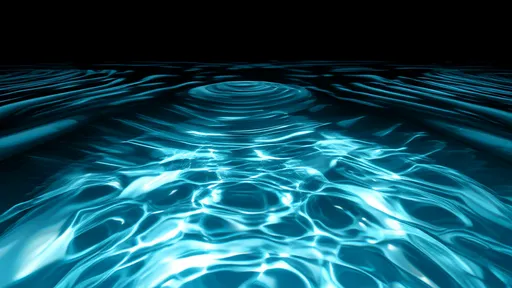
The pursuit of photorealistic water rendering has long been a holy grail in computer graphics. Among the most challenging effects to simulate convincingly are caustics – those intricate patterns of light that form when sunlight refracts through wavy water surfaces onto submerged objects or seabeds. Recent advancements in real-time rendering techniques have brought us closer than ever to achieving this elusive effect without compromising performance.
Traditional approaches to caustics rendering relied heavily on precomputed photon mapping or offline ray tracing, making them unsuitable for interactive applications. The gaming and simulation industries demanded a paradigm shift – techniques that could generate believable caustics at 60 frames per second or higher. This need sparked innovation across multiple fronts in real-time graphics research.
One breakthrough came with the realization that screen-space techniques could approximate caustics with surprising accuracy. By analyzing the depth buffer and surface normals of water geometry, shaders can project distorted light patterns that mimic the optical behavior of real water. The key innovation lies in the efficient reprojection of these patterns using the water surface's animated normal map, creating the illusion of light bending through waves.
Modern game engines have adopted hybrid approaches that combine the strengths of multiple methods. Signed distance fields (SDFs) prove particularly effective for representing the water surface's influence on light paths. When paired with compute shaders that perform rapid intersection tests, these systems can generate dynamic caustic patterns that respond to both the water's movement and the viewer's perspective.
The computational efficiency of contemporary caustics rendering stems from clever approximations of physical light transport. Rather than simulating every photon's path, algorithms focus on the statistically significant patterns that the human eye perceives as realistic. This perceptual rendering approach enables stunning visual fidelity while maintaining tight frame budgets.
Hardware advancements have played a crucial role in enabling these techniques. The latest graphics processors with dedicated ray tracing cores can accelerate certain aspects of caustics simulation, while compute shaders handle the bulk of the wave-optics calculations. This division of labor allows even complex marine environments to maintain smooth performance.
Looking ahead, researchers are exploring machine learning approaches to predict caustic patterns based on water surface characteristics. Early results suggest neural networks could eventually generate plausible caustics with minimal computational overhead. However, current implementations still struggle with temporal consistency – a critical requirement for real-time applications.
The implications of robust real-time caustics rendering extend beyond gaming. Marine simulation, architectural visualization, and virtual production all stand to benefit from these advancements. As the techniques mature, we're likely to see them become standard features in graphics pipelines, much like dynamic shadows or ambient occlusion before them.
What makes modern caustics rendering particularly exciting is its scalability. The same fundamental techniques can produce everything from subtle poolside light patterns to dramatic underwater cathedral effects, all controllable through artist-friendly parameters. This flexibility ensures the technology will find applications across diverse visual styles and genres.
While challenges remain in handling complex light interactions at air-water interfaces, the progress in recent years has been remarkable. The next frontier involves coupling these caustic effects with equally sophisticated water surface shading and subsurface scattering. When these elements converge seamlessly, the result is digital water that becomes indistinguishable from reality.
For developers implementing these techniques, the key lies in balancing physical accuracy with artistic control. The most successful implementations provide tools that automatically handle the complex optics while allowing artists to tweak the visual style. This marriage of technology and creativity is what ultimately sells the illusion to audiences.
As real-time graphics continue their relentless march toward photorealism, water caustics represent one of the final frontiers. The solutions emerging today point toward a near future where every ripple and wave comes alive with perfectly rendered light, completing the illusion of virtual aquatic environments. For graphics programmers and artists alike, these are exciting times indeed.
By /Jul 29, 2025
By /Jul 29, 2025
By /Jul 29, 2025

By /Jul 29, 2025

By /Jul 29, 2025
By /Jul 29, 2025

By /Jul 29, 2025
By /Jul 29, 2025

By /Jul 29, 2025

By /Jul 29, 2025
By /Jul 29, 2025

By /Jul 29, 2025

By /Jul 29, 2025

By /Jul 29, 2025

By /Jul 29, 2025

By /Jul 29, 2025
By /Jul 29, 2025
By /Jul 29, 2025

By /Jul 29, 2025
By /Jul 29, 2025
